Author: paulgabriel

  • The Returner Archetype: Why Workforce Re-entry Is Different

    The Returner Archetype: Why Workforce Re-entry Is Different

    Most career-change advice was written for someone who’s currently working. Read this résumé technique, run that company search, work this networking strategy. The advice assumes a baseline of recent professional activity and current professional context.

    Returners don’t have that baseline. They’re coming back to work after time away. The time away might have been caregiving for a child, an aging parent, or a partner. It might have been recovery from illness, divorce, or burnout. It might have been a sabbatical, a deliberate reset, a season of grief, or a period of figuring out who they are without their job. The cause varies; the structural reality is the same. They’ve been out, and they’re coming back, and the rules they remember from before have changed.

    Generic career advice fails Returners on three specific points.

    1. The gap is the first conversation, not the last

    Generic résumé guides tell you to “explain the gap.” Returners know that the gap isn’t something to explain after the recruiter is interested. The gap is what the recruiter sees first, and how you frame it determines whether anyone reads further.

    The Returner’s résumé strategy starts with the gap, on purpose. A line directly under your name that says “Returning to [field] after [reason for time away]” reframes the conversation before it can go in the wrong direction. The recruiter doesn’t have to wonder what they’re looking at. You’ve told them.

    This is the opposite of what most résumé advice tells you to do. Most advice says hide the gap, minimize it, push it down the page. The Returner archetype says do the reverse. Lead with it. Own it. Move on.

    2. Your network has rotated under you

    Most networking advice assumes you have an active professional network. Returners often don’t. The contacts who knew you have moved companies, taken new roles, retired, or simply faded. The current people in your former companies don’t know your name.

    Returners need a re-introduction strategy, not a networking strategy. That’s a different motion. Re-introduction is shorter, more explicit, and less transactional. “I worked at [company] from [year] to [year]. I’ve been out for [duration]. I’m coming back. I’d like to learn what’s changed.” That’s the whole opening. It’s not a pitch. It’s a request to be re-oriented to a profession the Returner used to belong to.

    3. Skills depreciate, but judgment doesn’t

    The thing Returners often don’t realize is that the skill depreciation is real but partial. The specific tools, platforms, and frameworks have changed. The judgment about how work happens, how teams function, how decisions get made, how organizations behave, that doesn’t depreciate.

    Generic career advice treats Returners as if they’re starting over. They’re not. They’re updating tooling on top of intact judgment. That distinction changes the role they should be applying for, the salary they should expect, and the kind of conversation they should be having with hiring managers.

    The Returner is not a junior candidate with a long gap. The Returner is a mid- or senior-level practitioner with current tooling to refresh.

    Why this matters for institutions

    Workforce re-entry is one of the two fastest-growing career-change populations in 2026 and beyond. The other is automation displacement (the Adapter archetype, covered separately). Programs that serve Returners include workforce development boards working on caregiver re-entry, university programs serving non-traditional students, apprenticeship initiatives, and outplacement firms working with executives returning from sabbatical or health-related leaves.

    Generic career frameworks fail this population because they assume continuity. The Returner archetype is built for the discontinuity. The Career Remake Assessment identifies Returners explicitly, and the worksheets in the Remake Your Career framework route them through tools sequenced for re-entry: gap framing first, re-introduction networking, judgment-forward résumé, salary calibration based on judgment, not just tooling.

    The Career Remake Assessment is the only career diagnostic with a dedicated Returner pathway. For programs serving workforce re-entry populations, see For Organizations.

    For Returners working through it on their own, the book is at 33 Tools to Remake Your Career, and the eight-archetype assessment lives in the companion workbook.

    The whole game changes when re-entry is treated as a distinct path, not a long version of generic job search.


    Paul Gabriel Dionne is the author of 33 Tools to Remake Your Career and the founder of Remake Press. The Remake Your Career framework is available for individual readers and for institutional use through universities, community colleges, workforce development programs, and outplacement firms. Learn more at For Organizations.
  • Why Most Career Assessments Stop Where the Hard Part Starts

    Why Most Career Assessments Stop Where the Hard Part Starts

    If you’ve ever taken Strong Interest Inventory, the Highlands Ability Battery, MAPP, or any of the dozens of career assessments out there, you know how the experience ends.

    A counselor walks you through your results. You learn that you score high in investigative thinking, or that your Holland code is RIA, or that your aptitudes lean toward design and abstract reasoning. You’re handed a printout. You’re shown a list of careers that match your profile. You leave the office feeling, briefly, like you understand yourself better.

    Then Monday morning comes. And you sit at your desk, with your printout, and you have no idea what to do next.

    This isn’t the assessment’s fault. It’s the assessment’s design.

    What assessments are built to do

    Career assessments are diagnostic tools. They’re built to answer one question: who is this person, in terms relevant to work?

    That’s a real question. The answers are useful. Knowing your aptitude profile, interest pattern, or personality type helps you understand why some kinds of work feel natural and others feel like dragging a heavy weight uphill. It explains the past. It frames future possibilities.

    What it does not do is tell you what to do on Monday morning.

    The gap

    The gap between “you would be good at X” and “here’s how you actually become X” is enormous. It’s where most career-change attempts collapse.

    A 45-year-old marketing director who scores high in investigative-realistic-artistic might be told she’d thrive in industrial design. Now what? Does she go back to school? Take an online certificate? Apply to entry-level roles and accept a $60K pay cut? Talk to industrial designers? Build a portfolio? Read a book?

    Yes, all of those, in some order, with some priority. But which one this Wednesday? The assessment doesn’t say.

    Where execution-focused frameworks pick up

    This is where the Remake Your Career framework starts. Not “what should you be” but “given where you are, what do you do next, in what order, with what worksheet.”

    The 24-statement Career Remake Assessment doesn’t tell you your aptitudes or your Holland code. It tells you what archetype best describes your situation right now: in pain at work and needing to leave (Survivor), stopped moving and not sure why (Stagnator), already out and rebuilding (Escapee), knows the destination but not the path (Pivoter), curious but pre-commitment (Investigator), on the right track and accelerating (Builder), returning to work after time away (Returner), or facing AI- or automation-driven change (Adapter).

    Each archetype routes you to a different set of tools, in a different order. The Survivor‘s first tool isn’t the Pivoter‘s first tool. The Returner‘s résumé strategy isn’t the Adapter‘s résumé strategy. The framework’s value isn’t in the diagnosis. It’s in the routing.

    Why this matters for career counselors and institutions

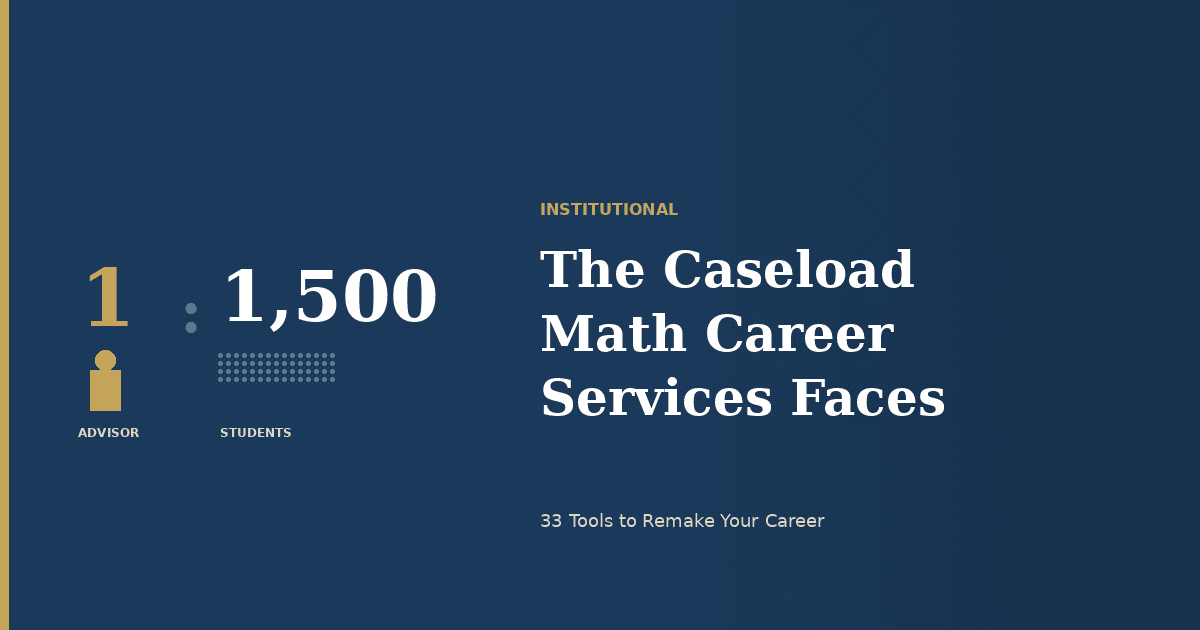
    If you’re a career counselor, advisor, or program director, you’ve seen this gap from your side too. You administer SII, Strong, or Highlands. You debrief the client. You know that the printout isn’t enough. You know they need execution support, but you don’t have time to walk every client through the next 33 weeks of work.

    The execution layer is what your clients are missing. The book and workbook are designed to be that layer, with the Career Remake Assessment providing the bridge between your diagnostic work and the participant’s daily action. Your clients leave your sessions knowing themselves. They come to the framework knowing what to do.

    This pairs especially well for practitioners who run aptitude or interest assessments and don’t have a downstream execution product. Johnson O’Connor, Highlands certified consultants, NCDA and NBCC members, and counselors at university career centers fit this pattern.

    What an execution-focused framework looks like

    The Remake Your Career framework consists of a 24-statement diagnostic that places the participant in one of eight archetypes, 33 sequenced tools across four phases (Build, Research, Connect, Navigate), archetype-specific routing that tells participants which tools to use, in what order, and worksheets and templates for every tool.

    It is not a personality test. It is not an aptitude diagnostic. It does not replace SII or Strong or Highlands. It picks up where they leave off.

    If you’ve been frustrated by the gap between assessment and action, you’re not the only one. The gap is real and it’s the central reason most career-change journeys take years longer than they should.

    For individual career changers, the book is at 33 Tools to Remake Your Career. For career counselors, advisors, and institutional programs interested in licensing the framework, see For Organizations.

    The whole game changes when assessment is followed by routing.


    Paul Gabriel Dionne is the author of 33 Tools to Remake Your Career and the founder of Remake Press. The Remake Your Career framework is available for individual readers and for institutional use through universities, community colleges, workforce development programs, and outplacement firms. Learn more at For Organizations.
  • The Six Reasons Smart Candidates Get Filtered Out (None of Them Are You)

    The Six Reasons Smart Candidates Get Filtered Out (None of Them Are You)

    When I was working as a recruiter, I’d review somewhere between thirty and a hundred résumés before lunch. Most got eliminated in the first scan. Most of those eliminations had nothing to do with the candidate.

    That’s a hard thing to believe when you’re on the other side of the desk, sending fifty applications and getting silence. The story most of us tell ourselves is “I must not be qualified,” or worse, “there’s something wrong with me.” Both are usually wrong. There’s almost always something wrong with the structural match between your résumé and what the recruiter is scanning for, and structural problems are fixable.

    Here are the six things I saw most often. None of them are about whether you’re good at the job.

    1. Your most recent title doesn’t match the role title

    Recruiters scan for title alignment in the first two seconds. If you’re applying for “Senior Data Analyst” and your most recent title is “Reporting Specialist,” your résumé is in trouble before anyone reads a word about what you actually did. Even if “Reporting Specialist” did identical work to “Senior Data Analyst” at your last company, the title field is doing the screening.

    The fix isn’t to lie. It’s to update your résumé title to match the role you’re applying for, then prove the match in the bullets below. You’re not changing what you did. You’re changing what you call it.

    2. Your years of experience don’t add up at a glance

    Recruiters do title math fast. If you’ve held three jobs in two years, that reads as a job-hopper risk and your résumé moves to the bottom of the pile. If you have a four-year gap with no explanation, that reads as “needs to be asked about,” which means it doesn’t get asked about.

    Both situations are fixable. Multiple short stints can be reframed as a single contract or consulting period. Gaps can be labeled (caregiver, sabbatical, founder of your own project) so the recruiter doesn’t have to imagine the worst.

    3. Your most recent employer isn’t recognized

    If you’re applying for a role at a Fortune 500 and your last employer is a five-person agency, the recruiter has no mental shortcut for evaluating whether you operated at the right altitude. They’ll skip over you in favor of someone whose last logo they recognize, even if you’d be better at the job.

    The fix is to add one line of context after the company name. “ACME Consulting (10-person boutique advising Fortune 500 supply chain teams)” tells the recruiter what to think before they have to figure it out themselves.

    4. Your location doesn’t fit the role’s radius

    Hybrid and remote postings still have geographic constraints baked in for tax, time zone, and team-cohesion reasons. If your résumé says Phoenix and the role is in Boston with “occasional travel,” you’re filtered before the second pass. Recruiters don’t always know exactly where they can hire. They just know where they’re sure they can’t.

    If you’re open to relocating, say so explicitly on the résumé. Don’t make the recruiter guess.

    5. Your résumé doesn’t match the job description’s keywords

    This is the ATS problem. The applicant tracking system scores your résumé against the job description before any human sees it. If the JD uses “stakeholder management” and your résumé says “client relationships,” the system reads those as different things even though they mean roughly the same thing.

    This isn’t about gaming the system. It’s about speaking the same language as the role. Read the JD twice. Identify the five most-repeated phrases. Make sure those five phrases appear, naturally, in your résumé.

    6. Your résumé is hard to skim in six seconds

    If your name and title are buried under a paragraph of personal mission statement, you’ve lost the scan before it started. The first six seconds of recruiter attention go to the title, the most recent role, the dates, and the company. If those four things aren’t visible in a glance, you’re filtered.

    This is the easiest fix on the list. Your name and current title at the top in size 14. Most recent role with dates and company-line right below. White space matters more than you think.

    What this all means

    Most of these are structural problems with structural fixes. None of them are about your worth as a candidate. None of them are about whether you’d be good at the job.

    If you’ve been running into a wall for weeks, the wall is almost certainly one of these six things, not you.

    The first seven tools in 33 Tools to Remake Your Career are designed specifically to clear the structural scan. Title alignment, gap framing, employer context, location signals, ATS keyword density, and résumé readability. Once you clear the scan, the rest of the framework works.

    The whole game changes when you understand what the reader is actually doing.


    Paul Gabriel Dionne is the author of 33 Tools to Remake Your Career and the founder of Remake Press. The Remake Your Career framework is available for individual readers and for institutional use through universities, community colleges, workforce development programs, and outplacement firms. Learn more at For Organizations.
  • What Recruiters Actually Do With Your Résumé

    What Recruiters Actually Do With Your Résumé

    When I was working as a recruiter, I would sometimes look up at the clock and realize I had reviewed forty-seven résumés that morning. That was an average morning.

    Most career changers think a recruiter sits down with their résumé, reads it carefully, considers their qualifications, weighs the strengths against the gaps, and writes thoughtful feedback. None of that happens.

    Here is what actually happens.

    You upload your résumé. It enters an applicant tracking system that scans for keywords from the job description. If your keyword density is below a threshold, the system files you in a stack the recruiter never opens. If you pass that filter, you land in a queue with sixty to two hundred other résumés.

    The recruiter opens the queue. She has thirty minutes before her next call. She has sixty to two hundred résumés to triage. The math is brutal: somewhere between six and twenty seconds per résumé.

    In those seconds, she is not reading. She is scanning for elimination criteria.

    Title at top? Does it match the role? Years of experience? Do they line up? Most recent employer? Recognizable? Location? Within the radius? Education? Above the bar? She is not asking “is this person good.” She is asking “is there a reason to remove this résumé from the pile.”

    If a single elimination criterion fires, she moves on. If none fire in those few seconds, you make it to the second pass, a longer read of maybe ninety seconds where she actually evaluates fit.

    Most candidates never make it to the second pass. They get eliminated in the scan.

    What this means for you

    Most career advice tells you to “tell your story” or “let your personality shine through.” That advice was written by people who have never been on the other side of the desk. Personality has nothing to do with what the recruiter is doing in those six seconds. She doesn’t read prose. She doesn’t have time to.

    What works in the scan is structural. Your title at the top has to match the role. Your years and progression have to be visible without effort. Your relevant employers have to be where the eye lands. Your keywords have to map to the job description with enough density to clear the ATS filter and to be obvious in the scan.

    This is not about being fake or robotic. It is about understanding what the reader is actually doing and giving her what she needs to keep reading. The story, the personality, the specific projects, the evidence of judgment, all that lives in the second pass and in the interview. The first pass is a structural test. Pass the test, and the rest of you gets read.

    The reframe that matters

    When I was a recruiter, I rejected somewhere around 95% of the résumés I saw. Almost none of those rejections were about the candidate. They were about role fit, location, timing, ATS keyword scoring, market saturation, internal candidates, hiring freezes I knew about and the candidate didn’t, role descriptions written for someone the company had already informally identified, and dozens of other reasons that had nothing to do with the person on paper.

    If you have been job searching for any length of time, you already know the experience of getting rejected from roles you were clearly qualified for. You probably have a story you tell yourself about why. Most of those stories are wrong. The rejection was almost certainly a structural mismatch you had no way of seeing from your side.

    This is not consolation. It is information. The job search is not a verdict on you. It is a process you are competing in, with rules you can learn.

    What to do with this

    Three things.

    First, write your résumé for the scan. Title at top. Years and progression visible. Keywords from the JD in the right places. The narrative arc lives in the cover letter, the interview, and the second-pass read, not in the first six seconds.

    Second, stop taking rejection personally. You are not getting rejected forty-seven times. You are getting filtered forty-seven times by a system that has very little to do with you. Your job is to keep showing up at the front of more queues, not to figure out what is wrong with you.

    Third, learn the system. The 33 tools in 33 Tools to Remake Your Career are organized around what recruiters actually do, not what most career advice assumes they do. The first seven (the Build section) are designed specifically to clear the scan. If you can clear the scan reliably, the rest of the framework works.

    The whole game changes when you understand who is reading and what they are looking for.


    Paul Gabriel Dionne is the author of 33 Tools to Remake Your Career and the founder of Remake Press. The Remake Your Career framework is available for individual readers and for institutional use through universities, community colleges, workforce development programs, and outplacement firms. Learn more at For Organizations.