When I was working as a recruiter, I would sometimes look up at the clock and realize I had reviewed forty-seven résumés that morning. That was an average morning.
Most career changers think a recruiter sits down with their résumé, reads it carefully, considers their qualifications, weighs the strengths against the gaps, and writes thoughtful feedback. None of that happens.
Here is what actually happens.
You upload your résumé. It enters an applicant tracking system that scans for keywords from the job description. If your keyword density is below a threshold, the system files you in a stack the recruiter never opens. If you pass that filter, you land in a queue with sixty to two hundred other résumés.
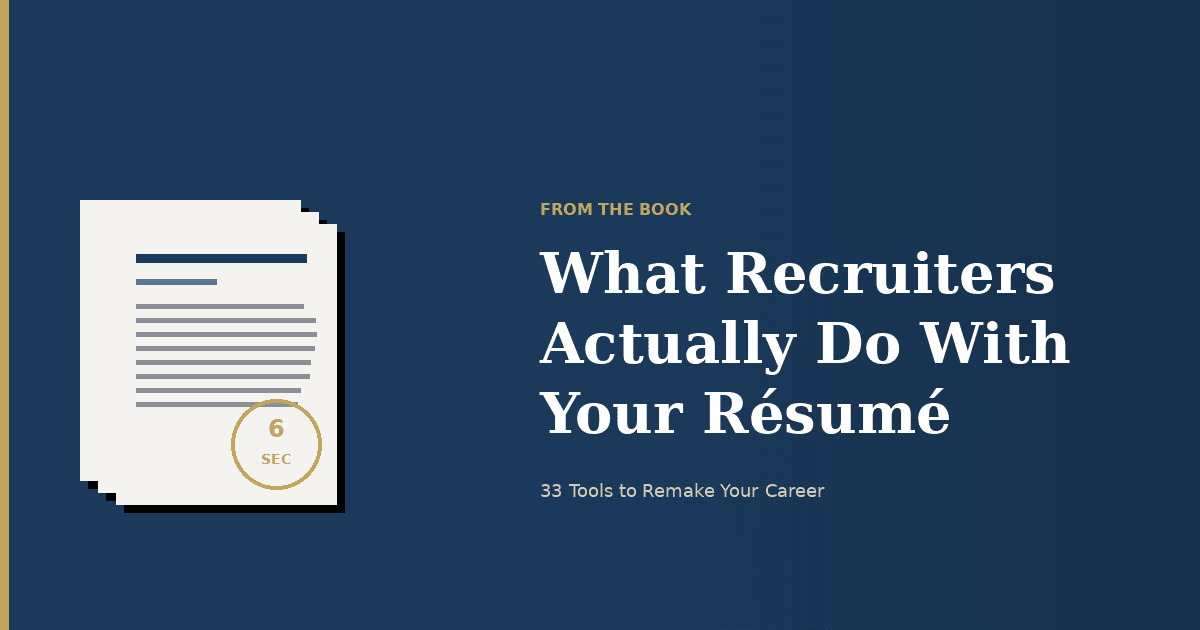
The recruiter opens the queue. She has thirty minutes before her next call. She has sixty to two hundred résumés to triage. The math is brutal: somewhere between six and twenty seconds per résumé.
In those seconds, she is not reading. She is scanning for elimination criteria.
Title at top? Does it match the role? Years of experience? Do they line up? Most recent employer? Recognizable? Location? Within the radius? Education? Above the bar? She is not asking “is this person good.” She is asking “is there a reason to remove this résumé from the pile.”
If a single elimination criterion fires, she moves on. If none fire in those few seconds, you make it to the second pass, a longer read of maybe ninety seconds where she actually evaluates fit.
Most candidates never make it to the second pass. They get eliminated in the scan.
What this means for you
Most career advice tells you to “tell your story” or “let your personality shine through.” That advice was written by people who have never been on the other side of the desk. Personality has nothing to do with what the recruiter is doing in those six seconds. She doesn’t read prose. She doesn’t have time to.
What works in the scan is structural. Your title at the top has to match the role. Your years and progression have to be visible without effort. Your relevant employers have to be where the eye lands. Your keywords have to map to the job description with enough density to clear the ATS filter and to be obvious in the scan.
This is not about being fake or robotic. It is about understanding what the reader is actually doing and giving her what she needs to keep reading. The story, the personality, the specific projects, the evidence of judgment, all that lives in the second pass and in the interview. The first pass is a structural test. Pass the test, and the rest of you gets read.
The reframe that matters
When I was a recruiter, I rejected somewhere around 95% of the résumés I saw. Almost none of those rejections were about the candidate. They were about role fit, location, timing, ATS keyword scoring, market saturation, internal candidates, hiring freezes I knew about and the candidate didn’t, role descriptions written for someone the company had already informally identified, and dozens of other reasons that had nothing to do with the person on paper.
If you have been job searching for any length of time, you already know the experience of getting rejected from roles you were clearly qualified for. You probably have a story you tell yourself about why. Most of those stories are wrong. The rejection was almost certainly a structural mismatch you had no way of seeing from your side.
This is not consolation. It is information. The job search is not a verdict on you. It is a process you are competing in, with rules you can learn.
What to do with this
Three things.
First, write your résumé for the scan. Title at top. Years and progression visible. Keywords from the JD in the right places. The narrative arc lives in the cover letter, the interview, and the second-pass read, not in the first six seconds.
Second, stop taking rejection personally. You are not getting rejected forty-seven times. You are getting filtered forty-seven times by a system that has very little to do with you. Your job is to keep showing up at the front of more queues, not to figure out what is wrong with you.
Third, learn the system. The 33 tools in 33 Tools to Remake Your Career are organized around what recruiters actually do, not what most career advice assumes they do. The first seven (the Build section) are designed specifically to clear the scan. If you can clear the scan reliably, the rest of the framework works.
The whole game changes when you understand who is reading and what they are looking for.
Paul Gabriel Dionne is the author of 33 Tools to Remake Your Career and the founder of Remake Press. The Remake Your Career framework is available for individual readers and for institutional use through universities, community colleges, workforce development programs, and outplacement firms. Learn more at For Organizations.